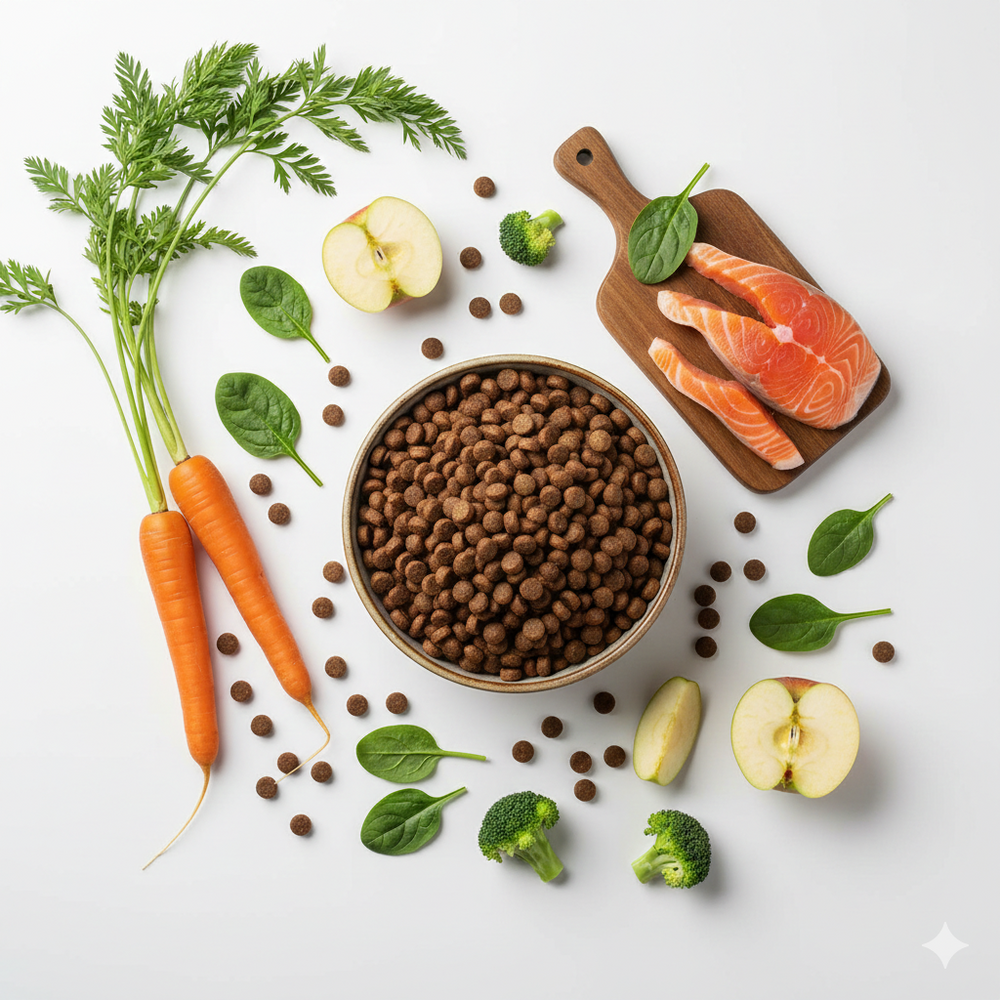
Wet food doesn't replace dry food: it complements it, and for one specific reason: water. A wet food can contains between 70% and 80% water; dry food, less than 10%. Because cats naturally drink very little, wet food is the easiest way to get water into their diet without a battle over the bowl. The approach that works in almost every case is dry food as the base, with wet food every day as part of the ration.
Why water is the real argument
The domestic cat descends from a desert-dwelling feline. Its thirst drive is weak because in its natural diet water didn't come from a puddle: it came from the prey, which is moist. When we feed an exclusively dry diet, that mechanism doesn't make up the difference and the cat ends up chronically short of water.
The practical consequence is more concentrated urine. That is why, with any history of urinary problems, the first thing to adjust is not a supplement: it's increasing the water in the diet.
What each format offers, without the marketing
| Dry food | Wet food | |
|---|---|---|
| Water | less than 10% | 70-80% |
| Calories per gram | high | low |
| Fullness per serving | lower volume | higher volume |
| Storage once opened | weeks | 24-48 h refrigerated |
| Cost per kcal | lower | higher |
In short: dry food wins on convenience and cost, wet food wins on water and fullness. That's why the answer isn't to choose one, it's to combine them.
How to split dry and wet food
The simple way to do it without complicated math: keep dry food as the base of the daily ration and add one can a day, subtracting the proportional amount of dry food. For an adult cat weighing 4-5 kg, one 80 g can a day is a reasonable reference as a complement.
Three details that matter more than they seem:
- Serve wet food at room temperature, not straight from the fridge: the cold kills the aroma and cats eat by smell.
- Remove whatever isn't eaten within 30-40 minutes. Wet food oxidizes quickly, and a cat that has tasted it stale won't want it again.
- Keep water away from the food. Cats prefer to drink away from their feeding spot; it's a reflex to avoid water contaminated by leftovers.
What we have for the wet food side
Our Tuna Wet Food Cans come in a pack of 3 x 80 g, with no artificial additives or preservatives, suitable for dogs and cats of all ages. If you prefer to rotate the fish (and rotating is a good idea, both for nutrient variety and so your cat doesn't fixate on a single flavor), there are also the Mackerel Wet Food Cans, in the same 3 x 80 g format.
For a dry food base for a neutered/spayed cat, the Neutered/Spayed Cat Dry Food with Tuna, Salmon and Chicken is formulated with probiotics for weight control and maintaining muscle mass, the two main concerns for a neutered/spayed cat.
And if you're looking for a treat rather than a meal, Dehydrated Anchovies are whole dehydrated fish with no additives, and they work just as well for cats as for dogs.
You can see the full range at wet food.